Manual QA vs QAby.AI: Who Should Own Your Regression?
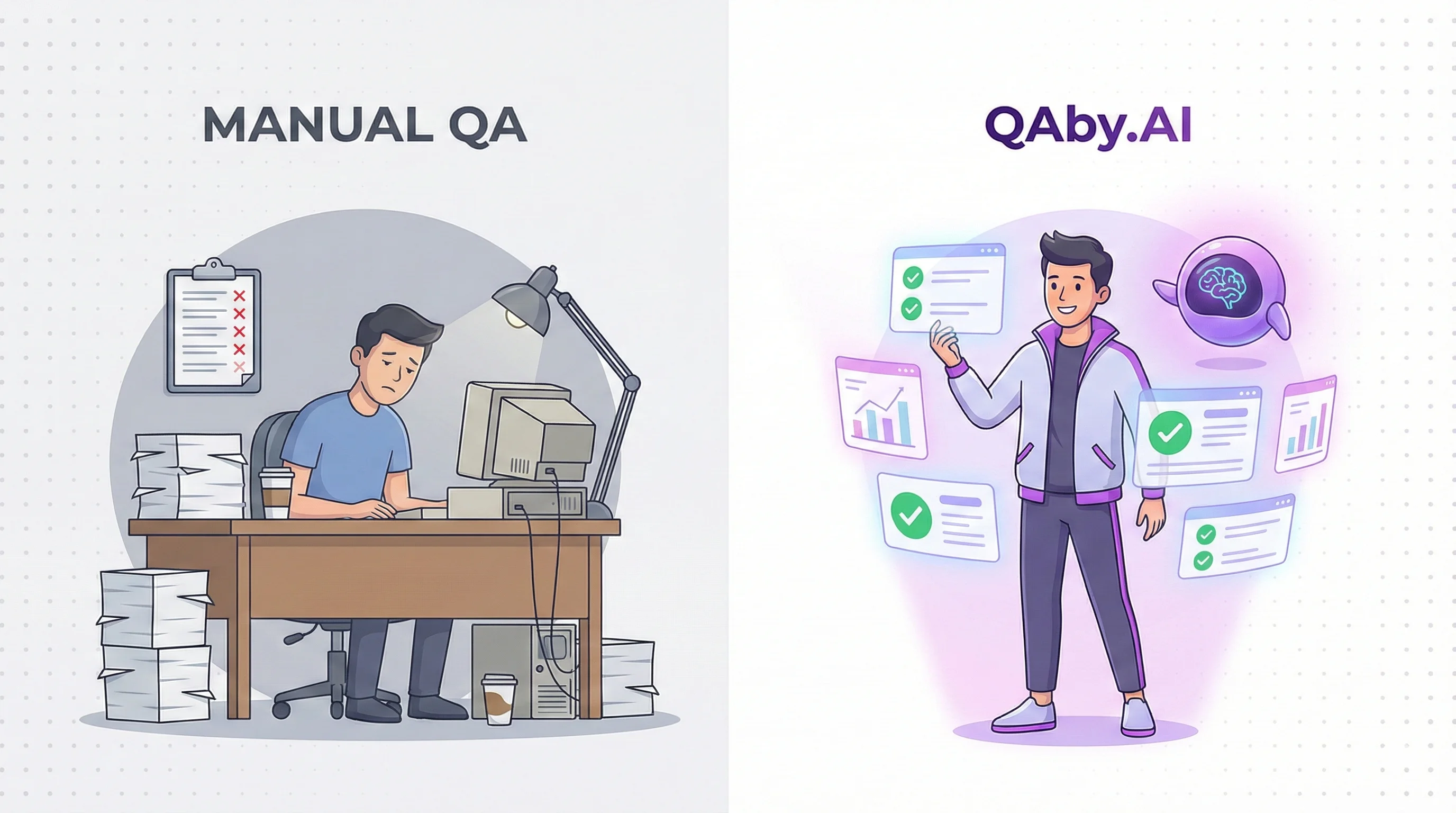
Manual QAs are wasted on regression. QAby.AI's agents run it on every merge — your testers go back to finding bugs that actually ship.
| Manual QA | QAby.AI | |
|---|---|---|
| Type | Human-run testing (click-through flows each release) | AI agent–led regression |
| Pricing | QA engineer salary ($60–120K/yr depending on market) | From $1,000/mo (credit-based) |
| Best for | Exploratory testing, edge cases, UX judgment calls | Repetitive regression on every merge |
| Test authoring | Tester follows scripts or tests exploratorily by hand | Agents discover + author tests from plain English |
| Maintenance | No maintenance needed — but retesting every release is repeated work | Agents self-heal on UI changes |
| CI/CD integration | Not integrated — runs on release day or sprint end | Native GitHub Actions / GitLab / Jenkins |
| Setup | None for tooling; relies on people and documentation | No selectors, no code required |
Here's an uncomfortable truth that nobody in tech wants to admit: We've been forcing square pegs into round holes for the past decade, and calling it "career development."
Every manual QA tester has heard it. "You need to learn automation. Manual testing is dead. If you don't code, you'll be left behind." We've created an entire industry narrative that says the only way up for a manual QA is to become an automation engineer.
But what if we've been solving the wrong problem all along? What if the issue isn't that manual QAs can't code, but that we've been asking the wrong people to ensure quality?
The paradigm is shifting. And it's not about replacing manual QAs with AI. It's about giving them superpowers.
The Current Reality of Manual QA
Let's paint the picture every engineering team knows too well:
Sprint ends Thursday. Release planned for Friday. Your manual QA team springs into action, clicking through the same flows they tested last sprint, and the sprint before that. They find bugs (they always do), create tickets, and the cycle continues.
It's Groundhog Day. Every release, same tests, same exhaustion.
The problems are obvious:
- It doesn't scale. Adding features means adding test scenarios exponentially
- It's mind-numbingly repetitive. Testing the login flow for the 500th time isn't quality assurance; it's quality theater
- It happens too late. Finding bugs right before release is like finding termites during the house inspection—technically good timing, practically a nightmare
There's a quieter problem underneath, too. For a lot of teams, manual QA isn't even a team — it's one person. Across 26 QA conversations we ran with engineering and QA teams, about 31% ran with no or minimal dedicated QA, several leaning on a single veteran who tests everything because there's no one else to trust. We call it the Single-Throat Bottleneck: your release confidence is one human deep, and it goes on leave when they do.
So we invented automation testing. Write the test once, run it forever. Problem solved, right?
Not quite.
The Automation Testing Trap
Here's what actually happened when we pushed manual QAs toward automation:
We asked quality experts to become mediocre programmers.
Think about it. You have someone with deep product knowledge, an intuitive understanding of user behavior, and a sixth sense for edge cases. Their superpower is thinking like a user and breaking things creatively.
Our solution? "Here, learn Playwright. Write some JavaScript. Oh, and figure out async/await while you're at it."
It's like asking a food critic to become a chef. Sure, they both work with food, but the skillsets are fundamentally different.
The dirty secret of test automation is that most automated test suites are:
- Brittle (one UI refactor breaks 50 tests)
- Shallow (they test the happy path and little else)
- Written by people who learned coding to keep their jobs, not because they love it
We didn't solve the quality problem. We just created a new one: bad automation written by reluctant programmers.
Enter AI: Smart Manual QAs beat dumb Automation QAs
This is where everything changes. AI doesn't care if you know Python or JavaScript. It doesn't care if you understand promises or can debug a flaky Playwright test.
AI cares about one thing: Can you clearly communicate what needs to be tested?
Suddenly, the playing field isn't just level—it's completely transformed. The manual QA who deeply understands your product can now write better tests than the automation engineer who's still figuring out what your app actually does.
Consider this scenario:
Traditional Automation QA approach:
// 50 lines of code to test checkout flow
// Probably misses edge cases because the developer
// doesn't actually use the product daily
await page.goto('/checkout');
await page.fill('#email', 'test@example.com');
// ... etc
AI-Empowered Manual QA approach:
"Test the checkout flow. Make sure to verify:
- Discount codes work correctly with sale items
- The tax calculation updates when changing shipping address
- The 'save for later' items persist across sessions
- PayPal redirects maintain cart state

Oh, and that weird bug where clicking back from payment
sometimes duplicates items? Check for that too."
Who would you rather have testing your product? The person who knows your application inside out, or the person who knows Selenium inside out?
With AI, smart manual QAs beat dumb automation QAs. Every. Single. Time.
The Real Paradigm Shift
We're not just changing tools. We're changing the entire equation of what makes a great QA professional.
Before AI:
- Manual QA → Learn to code → Automation QA → Maybe become good at it eventually
With AI:
- Manual QA → Use AI tools → Instantly productive automation → Focus on quality, not syntax
This isn't about manual QAs "catching up" to automation engineers. This is about manual QAs skipping the entire coding requirement and going straight to what matters: ensuring quality.
Meanwhile, automation QAs face a different transformation. Their coding skills become less differentiating when AI can generate test code in seconds. They need to evolve too—perhaps into test architects, quality strategists, or AI QA prompt engineers. The pure "I write Playwright scripts" role is becoming as obsolete as the manual tester clicking through the same flow repeatedly.
The revolution isn't replacing humans with AI. It's replacing the need to code with the need to think.
Empowerment, Not Replacement
Let me be crystal clear: We're not replacing manual QAs. We're giving them Iron Man suits.
A manual QA with AI-powered tools can:
- Write comprehensive test suites without knowing any programming language
- Create tests as fast as they can describe scenarios
- Focus on edge cases and user experience instead of debugging locators
- Actually enjoy their job instead of feeling pressure to become something they're not
One empowered manual QA can now accomplish what previously required an entire automation team. Not because they're working harder, but because the barrier between their expertise and execution has been removed.
The New QA Professional
So what skills matter in this new world?
For Manual QAs, double down on:
- Product expertise: Know every feature, every user flow, every edge case
- Communication skills: The clearer you can describe what to test, the better your AI-powered tests
- Critical thinking: Identify what could go wrong, not how to code the test
- User empathy: Understand how real users actually use the product
What you DON'T need:
- Programming languages
- Framework knowledge
- Debugging skills for test code
- CI/CD pipeline expertise
The beautiful irony? The skills that make a great manual QA are exactly the skills that make someone exceptional at QA with AI. No transformation required. No career pivot needed. Just amplification of what you already do well.
The Bottom Line
We've spent years telling manual QAs they need to evolve or die. Learn to code or become obsolete. Automate or be automated.
We were wrong.
The future of QA isn't about replacing manual testers with automation engineers or AI. It's about recognizing that quality assurance is about quality, not code. It's about empowering the people who understand quality best with tools that don't require a computer science degree to operate.
Your manual QAs don't need to learn Python. They need AI tools that speak their language. They don't need to understand async/await. They need to understand your users.
Stop forcing your manual QAs to become mediocre programmers. Start empowering them to become exceptional quality advocates with AI superpowers.
The paradigm has shifted. The only question is: Will you shift with it, or keep pushing that boulder up the hill?
Ready to empower your manual QA team? Try QAby.AI free for 14 days or Book a demo to stop the endless cycle of manual testing and failed automation attempts.
Frequently asked questions
Will AI testing replace my manual QA team?
No. AI agents take over repetitive regression — the click-through-the-same-flows work manual QAs dread — while your testers move to exploratory testing, edge cases, and the judgment calls no model makes well. You get release confidence at engineering velocity without firing anyone; the boring half of the job goes to the agents.
What does manual QA still own when AI handles regression?
Manual QA owns everything that needs human judgment: exploratory testing, usability, ambiguous acceptance criteria, and the "this feels wrong" instinct that catches bugs no assertion was written for. AI agents discover your flows, build the tests, run them on every merge, and heal them when the UI changes — freeing your testers for the work that actually needs a person.
How do manual testers transition into AI-augmented workflows?
They stop writing scripts and start directing agents. Instead of learning Selenium just to stay employed, a manual QA reviews what the AI agents generated, flags the flows worth covering, and owns the exploratory edges. No coding bootcamp required — the skill shifts from authoring brittle automation to judging coverage and triaging real failures.
Is "manual testing dying" — what does the data say?
Manual testing isn't dying — script-writing as a career ladder is. The "learn automation or get left behind" narrative pushed testers toward mediocre coding when their real value is judgment. With AI agents handling regression, demand shifts toward testers who find the bugs that ship, not those who maintain selectors. The role changes; it doesn't disappear.
Related reading - [Your first QA hire will spend 2 months writing
scripts](/blog/playwright-vs-qaby-ai-cost) - How to evaluate AI testing tools without getting burned - Manual QA vs QAby.AI — full comparison - AI Magic — how QAby.AI runs natural-language automation - QAby.AI pricing