
Mabl vs QAby.AI: $30K Platform or Engineer-Owned Agents?
Mabl needs a QA Lead and $30K–$100K/yr. QAby.AI's agents run regression on every merge — from $1K/mo, owned by your engineering team. Compare.
| Mabl | QAby.AI | |
|---|---|---|
| Type | AI-augmented test platform (QA Lead–operated) | AI agent–led regression |
| Pricing | Quote-only; $30K–$100K/yr (mid-market est.) | From $1,000/mo (credit-based) |
| Best for | Teams with a dedicated QA Lead who wants a platform to live in | 50–200 eng teams, no SDET hired |
| Test authoring | Record-or-author flows in mabl's cloud UI | Agents discover + author tests from intent |
| Maintenance | ML self-healing selectors; tests live in mabl's cloud | Agents self-heal on UI changes; tests in Git |
| CI/CD integration | Your CI triggers mabl's cloud runners | Native GitHub Actions / GitLab / Jenkins |
| Setup | QA Lead operates the platform daily | No selectors, no code required |
Most "AI testing" comparison posts pretend the choice is AI vs not-AI.
That's not the real fork.
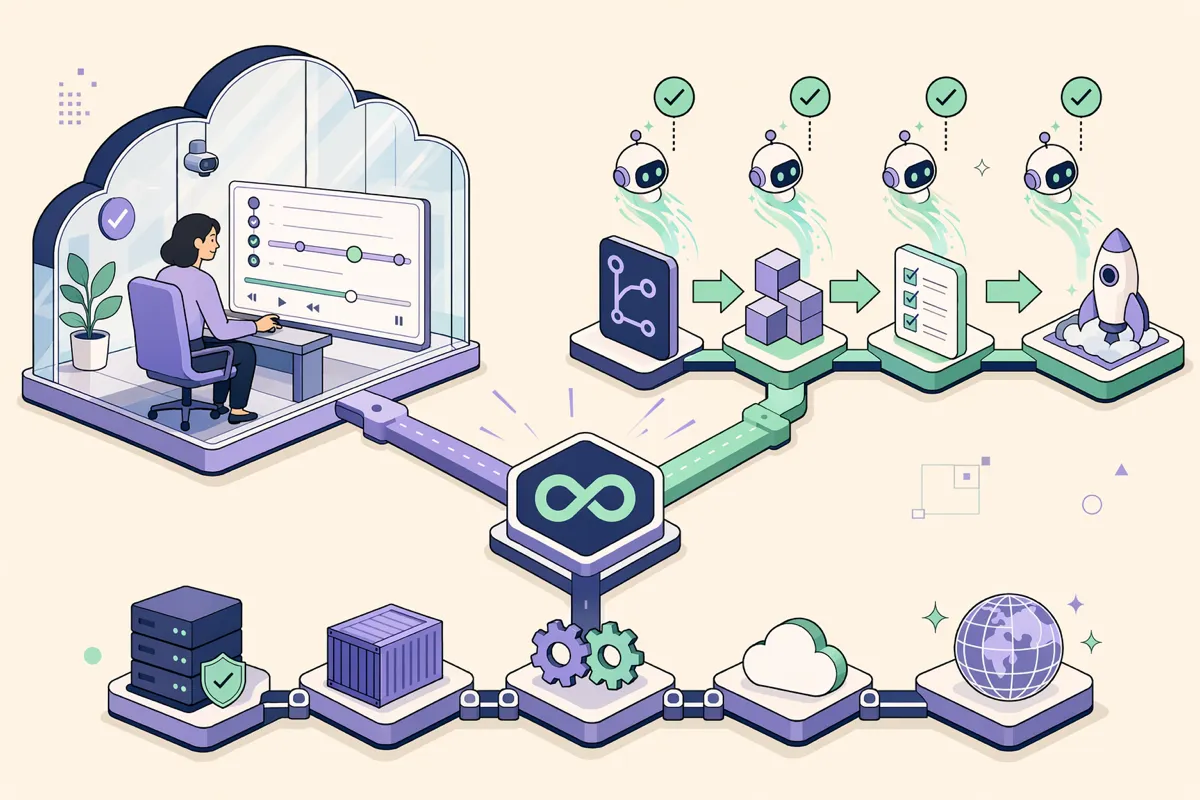
The real fork is who owns the suite — a QA platform a QA Lead lives in, or AI agents your engineers run from CI. Mabl picked the first answer in 2017 and has built around it ever since. QAby.AI picked the second.
TL;DR
- Mabl is an AI-augmented test platform built around a QA Lead — record-or-author flows in mabl's cloud UI, with ML self-healing selectors.
- QAby.AI is a team of AI agents owned by your engineers. The agents discover your flows, build the tests, run them on every merge, and heal them when your UI changes.
- Mabl pricing is quote-only, three tiers, annual contracts, 500 cloud-run credits/month baseline. Mid-market deployments past 100 active tests routinely land in the $30K–$100K/year band.
- Pick Mabl if you already have a QA Lead who wants a dedicated platform to live in. Pick QAby.AI if you want regression coverage without hiring the next SDET.
What does Mabl actually do?
Mabl is an AI-augmented test automation platform — you record or author flows in mabl's cloud UI, and machine learning watches the DOM to self-heal selectors when your app changes. The pitch is "low-code testing for QA teams that don't want to maintain Playwright."
The current product covers web, mobile, API, accessibility, and performance testing in one suite. Recent 2025–2026 releases shipped a Test Creation Agent for conversational test planning (mabl claims 2× faster generation) and Auto TFA — failure triage that drops summaries directly into Jira tickets or your IDE.
Their auto-healing model tracks elements across multiple attributes — text, position, neighboring DOM — not just a single CSS selector. When something moves, the test usually still passes. The reviewers we surveyed back this up:
"Auto-healing genuinely reduces maintenance overhead — stopped spending hours maintaining Selenium scripts." — Mabl customer via aitestingguide's 2026 Mabl review
The UI gets praise too:
"The Mabl interface is well designed with logical and consistent navigation — didn't feel lost even as a first-time user." — G2 reviewer, surfaced in drizz.dev's Mabl writeup
Where it fits: QA-Lead-owned, browser-first test creation. The platform expects a dedicated human inside it most days.
How is QAby.AI different from Mabl?
QAby.AI is a team of AI agents your engineers run from CI — the agents discover your flows, build the tests, run them on every merge, and heal them when your UI changes. The category isn't "AI testing platform." It's release confidence at engineering velocity, delivered by agents your team owns rather than a platform your QA Lead operates.
The four verbs at the heart of it:
| Verb | What the agent does | Where it runs |
|---|---|---|
| Discover | Crawls your app + reads your product context to find the flows worth testing | Engineer's local + CLI |
| Build | Writes the test cases from intent — no record-and-replay scrubbing | Engineer's local + CLI |
| Run | Plans fire on every PR, every merge, every deploy | GitHub Actions / GitLab / Jenkins / CircleCI |
| Heal | Intent-based execution — agents find the button even when the DOM moves | At runtime |
You don't context-switch into a separate QA tool. The suite is Git-native. The runs gate your deploys. The failure lands with the engineer who shipped the change, not the QA Lead two time zones away.
That's the wedge — not "more AI" than mabl. Different ownership model. The deeper take on engineer-owned regression versus framework code lives in our QAby.AI vs Playwright comparison.
How does Mabl pricing scale with team size?
Mabl pricing is quote-only — no published numbers, three tiers (Starter, Growth, Enterprise) on annual contracts, 500 cloud-run credits/month as the baseline. You buy more credits as you run more.
Third-party aggregators (SaaSworthy, Capterra) consistently put Starter in the low five-figures/year, with Growth and Enterprise scaling fast as run counts and seats climb. Mid-market deployments past 100 active tests typically land in the $30K–$100K/year band.
The honest reviewer cut on that price:
"A highly priced, overly complicated solution." — G2 reviewer, surfaced in drizz.dev's Mabl writeup
At $30K–$100K/year, the math gets honest. A mid-level SDET in the US runs $120–160k base, $200K+ loaded. So the buyer's real question isn't "Mabl vs no QA tool" — it's "Mabl plus the QA Lead who runs it, versus a team of AI agents your engineers own."
We broke the engineering-cost side of this down in Your First QA Hire Will Spend 2 Months Writing Scripts. The same math applies whether the platform is mabl or Playwright — the SDET hire is the line item, not the tool.
When does Mabl fit, and when doesn't it?
Mabl fits when you already have a QA Lead, that person wants a dedicated platform to operate from, and your release rhythm tolerates someone running suites by hand on most days.
It stops fitting when:
- You don't have a QA Lead and don't want to hire one.
- Your engineers want regression results inside their PR, not in a separate QA tool.
- You want test definitions in Git, version-controlled alongside the app code.
- You're shopping to replace an outsourced QA contract, not augment an existing QA team.
A common Reddit thread starts with the literal title "Anyone used or using mabl platform for testing — leave your feedback if possible" on r/QualityAssurance. Engineers shopping AI augmentation default to mabl because it's the mature option. Engineers shopping to skip the SDET hire usually don't — because mabl assumes the SDET (or the QA Lead doing SDET work).
If your problem is "we have a manual QA team and they're swamped," start with the Manual QA vs QAby.AI take. If your problem is "AI writes Playwright but the suite keeps breaking," start with the KaneAI vs QAby.AI comparison.
Can Mabl handle React SPAs, dynamic content, and CI/CD?
Yes — Mabl ships first-class support for SPAs (React, Vue, Angular), handles dynamic content via multi-attribute self-healing, and integrates with GitHub Actions, GitLab, Jenkins, CircleCI, and the rest of the mainstream CI stack.
Where reality lands: SPA support is solid until your team ships a UI redesign. Dynamic content is solid until your component library changes how it renders. CI integration works, but the run happens on mabl's cloud and reports back — your CI is a trigger, not a host.
The reviewer voice on cloud-run latency is consistent:
"Cloud execution is slower than running equivalent tests with Selenium or Playwright locally." — G2 reviewer aggregate
QAby.AI runs the suite from your CI (your runners, your network) and reports back in the same surface. Same CI hooks. Different ownership of the runtime. For the SPA edge cases that quietly break AI-augmented tools, see How to evaluate AI testing tools without getting burned.
What does Mabl NOT do well?
Mabl is honest about its position — it's an AI-augmented QA platform, not a layer your engineers own from CI. The trade-offs that surface in real customer conversations:
- Test definitions live in mabl, not Git. No PR review of test changes. No rolling back a bad test in the same commit that fixed the app. That's a structural choice mabl made in 2017, not a feature backlog item.
- Cloud-run credits cap behavior. Teams stretching the 500-credit baseline get nudged up the tier ladder. A real Capterra reviewer:
"Setting up the QA testing often didn't work as expected and took so long to run that it slowed down our entire development process."
- The QA Lead is the single point of operation. When she goes on PTO, the suite goes on PTO. Another Capterra voice:
"Managing mabl notifications could be difficult — took work to configure to only notify on what was important."
- Recording-first authoring slows you down at scale. Past 200 tests, agent-built test definitions read faster than scrubbing through recorded steps. The trade-off shows up the moment you need conditional logic:
"Complex conditional logic, multi-tab interactions, or custom authentication flows often require dropping into JavaScript snippets." — surfaced in drizz.dev's Mabl writeup
- Self-healing can hide as much as it fixes. Mabl's ML self-healing aims at the right pain — locator maintenance was the #1 problem for 35% of the 26 QA teams we interviewed. But auto-healing has a failure mode we call the Green-Pipeline Lie: the pipeline stays green because the tool quietly papered over a change that should have failed the test. A red test that tells the truth is worth more than a green one that doesn't.
None of these are dealbreakers. They're choices mabl made when it picked the QA-Lead-platform shape. If those choices match your org today, mabl is a fine answer. If they don't — keep looking. The longer read on what "fits your org" means is in Playwright vs QAby.AI.
Frequently asked questions
What does Mabl actually do?
Mabl is an AI-augmented test automation platform: you record or author flows in mabl's cloud UI, and ML self-heals selectors when the DOM changes. The current product covers web, mobile, and API testing. It targets QA Leads at mid-market companies who want a low-code alternative to maintaining Playwright or Selenium themselves.
How does Mabl pricing scale with team size?
Mabl is quote-only with three tiers (Starter, Growth, Enterprise) on annual contracts. Every plan includes 500 monthly cloud-run credits as a baseline; you pay more for additional credits, more seats, and enterprise features. Mid-market deployments past 100 tests typically land in the $30K–$100K/year range based on third-party aggregators.
Mabl vs Playwright vs Cypress — when does each win?
Playwright wins when you have engineers who genuinely want to own the test framework and time to maintain selectors. Cypress wins for frontend teams that want component plus E2E in the same repo. Mabl wins when you already have a QA Lead who wants a dedicated platform and your release rhythm tolerates QA running suites by hand.
Can Mabl handle React SPAs and dynamic content?
Yes — Mabl's multi-attribute self-healing tracks elements via text, position, and neighboring DOM nodes, so React, Vue, and Angular SPAs work without extra setup. Dynamic content holds up until a major component-library refactor. Most teams hit the edge cases during a redesign, when even self-healing models start asking for human review.
What does Mabl NOT do well?
Mabl test definitions live in mabl's cloud, not in Git. So you lose PR review of test changes, can't roll back a bad test alongside the commit that broke the app, and the QA Lead becomes the single point of operation. Run-credit overages also surprise teams that scale past the baseline 500 cloud runs a month.
Is Mabl right for a 50–200 engineer SaaS team without dedicated QA?
Probably not. Mabl is built around a QA Lead operating the platform daily. A 50–200 engineer team without that person is better served by AI agents that discover your flows, build the tests, run them on every merge, and heal them when your UI changes. The suite is Git-native; the runs gate your deploys; the failure lands with whoever shipped the regression.
How do I get regression coverage without hiring an SDET?
You skip the SDET hire by running AI agents from CI instead of standing up a QA platform that needs daily human operation. The agents discover the flows worth testing, build the cases, run on every merge, and heal when the UI changes. A mid-level SDET runs $120–160k base, $200K+ loaded — a subscription that lives inside your existing CI runs a fraction of that, no recruiting cycle, no ramp.
Can I migrate from Mabl to QAby.AI without rewriting tests?
Yes — most teams keep the mabl suite running while QAby.AI takes over new regression patterns. QAby.AI's agents run side-by-side with whatever you have today. You migrate the brittle parts (the ones costing the QA Lead the most maintenance time) first, then move the rest as confidence grows.